Sabbath #6

Appreciation, appreciating the times we inherit.

Having appreciation for the good, bad and the ugly; everything is masterfully planned, we cannot fully interpret this nature. Why can’t we? It surpasses human conscious and physicality, our minds cannot fathom just how massive and fluid the world and universe works. This is why, people deny God’s existence, or, embrace it. A sip of scientific research makes one atheistic, while a full glass makes one at least theistic and believe in the metaphysical. If one desires said theism they will become led to Christianity, if you desire truth you will find truth.

Random thoughts for today, have a blessed Sunday and keep peace in the home. Blessings

Sabbath #5

Good Morning, I’m currently away and cannot fulfill a full write. I sincerely apologize, my hopes and prayers are that everyone who stumbles upon this is at peace. There is always something to be grateful for, we always have something someone else is struggling for. If you have time to read this then that is a blessing, for you and I. Anyway, thank you and have a Blessed Sunday! >^..^<

Sabbath #4 Cheesefare Sunday

Today is the last Sunday before Great Lent, which is called “Cheesefare Sunday” or “Forgiveness Sunday”. It’s a time where we focus on the subject of forgiving others and finding peace through the pain that others have inflicted upon us, remembering that even though the pain is great, it is only temporary.

“For if ye forgive men their trespasses, your heavenly Father will also forgive you: but if ye forgive not men their trespasses, neither will your Father forgive your trespasses.”

Matthew‬ ‭6:14-15‬ ‭KJV‬‬

To add on, the topic of fasting (The Great Lent) is a key proponent during Forgiveness Sunday. During this time, it is good that we learn about what it means to truly fast. Not just physically, but spiritually and mentally as well. If we, humans, were to just physically fast, then what good is that to the soul?

“Moreover when ye fast, be not, as the hypocrites, of a sad countenance: for they disfigure their faces, that they may appear unto men to fast. Verily I say unto you, They have their reward. But thou, when thou fastest, anoint thine head, and wash thy face; that thou appear not unto men to fast, but unto thy Father which is in secret: and thy Father, which seeth in secret, shall reward thee openly.”‬‬

Matthew‬ ‭6:16-18‬ ‭KJV

In conclusion, today is a day in which we focus and reflect upon ourselves. How can we forgive more? What can we do to invoke the Holy Spirit in areas of our lives in which we lack said essence? Let us meditate on these things today. And remember, the 40-day Great Lent in which Jesus fasted in the desert and faced all temptations man has faced. God Bless all of those who are participating and all those who are not.

Bonus Land: Video On Forgiveness.

Sabbath #3

Think upon good deeds, it is a beautiful thing when we think of the beauty that is creation. Nature is music of the spheres, all the animals, plants, trees, and the elements sing in harmony according to his will. It truly is a beautiful thing to meditate upon. Praise God!

Our life depends on the kind of thoughts we nurture. If our thoughts are peaceful, calm, meek, and kind, then that is what our life is like. If our attention is turned to the circumstances in which we live, we are drawn into a whirlpool of thoughts and can have neither peace nor tranquility.”

Our Thoughts Determine Our Lives – Elder Thaddeus

Have a blessed week, if anyone needs prayer/someone to talk to; Contact me at my personal email: bummingwaffles@gmail.com

Sabbath #1

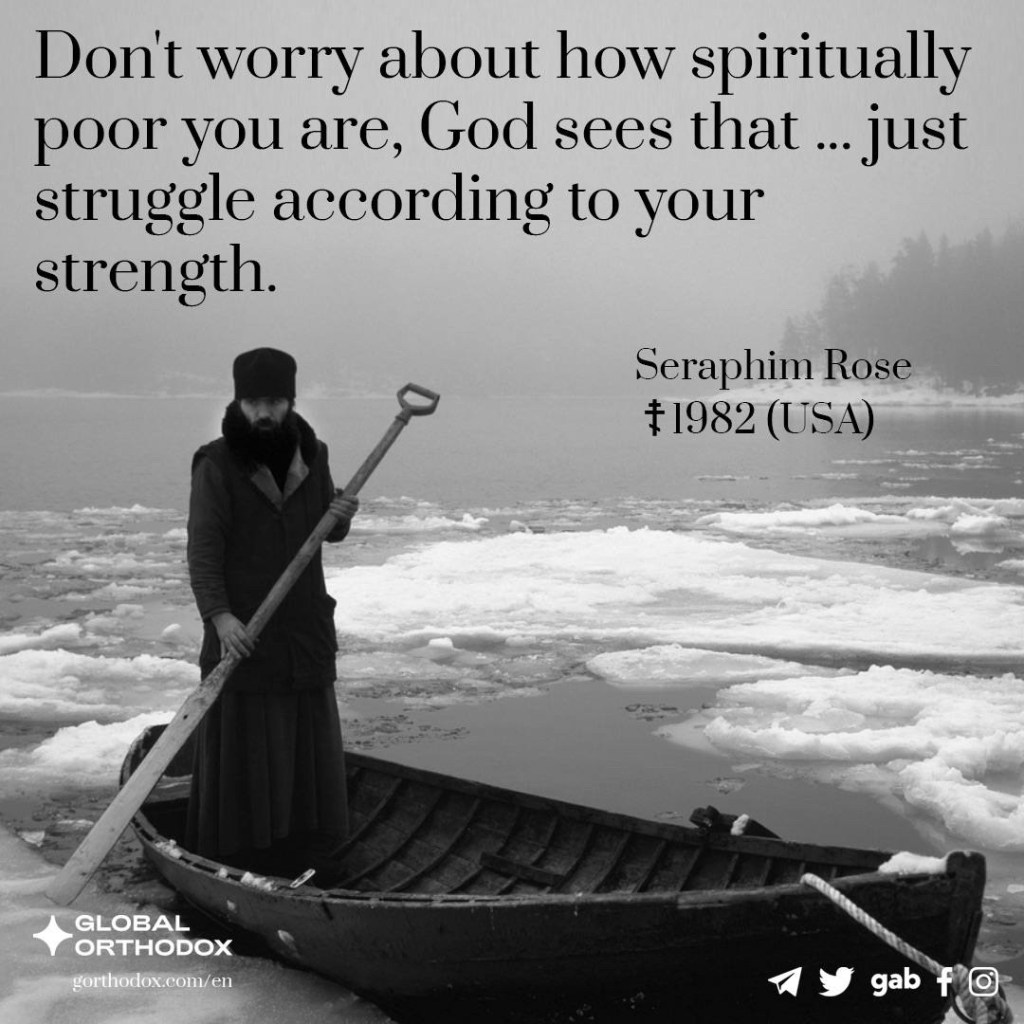
Why do men learn through pain and suffering, and not through pleasure and happiness? Very simply, because pleasure and happiness accustom one to satisfaction with the things given in this world, whereas pain and suffering drive one to seek a more profound happiness beyond the limitations of this world.

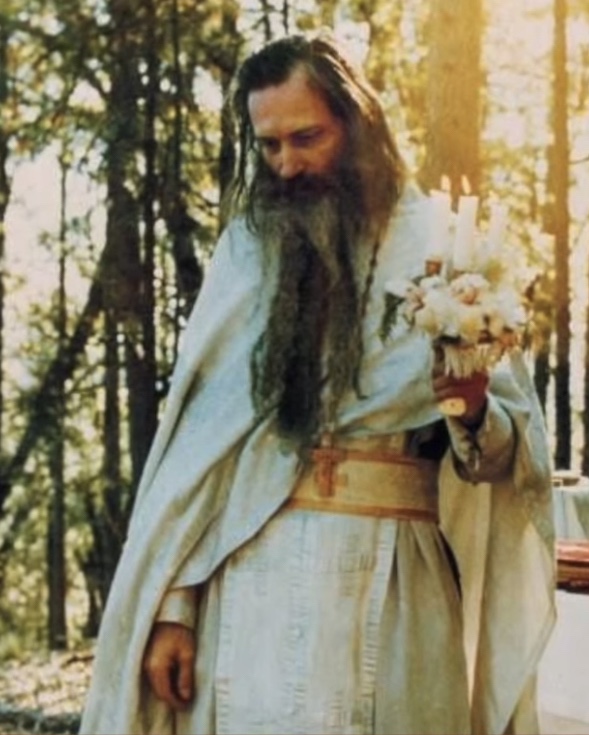
Fr. Seraphim Rose (1934-1982)
Fr. Serpahim Rose.

Short Write: Meekness Is A Blessing

“Blessed are the meek: for they shall inherit the earth.”
‭‭Matthew‬ ‭5:5‬ ‭

meek; quiet, gentle, and easily imposed on.

My friends, we can provide so much more to others through how we interact.

By being quiet, it allows us to sit and reflect on others. By doing so, we can exemplify others over ourselves.

By being gentle, we can provide compassion and true love to those around us.

Easily imposed on, meaning, almost docile. Accepting the situation your Father puts you in and realizing it is not your will but His.

Of course, always easier said than done. But, let this reminder show us that we need change. Always, we will never be “perfect just the way we are” because it doesn’t exist! We will always eventually be caught up in some sort of sin, we cannot be better than anyone else! exemplify others over yourself. But, also remember to love others like yourself. Meaning, don’t beat yourself up in order to make someone look better. Just think of others more than yourself!

Be Blessed and God watch over you friends.

Small Write: Why Do We Desire The World?

Why do we desire to be like others, why are we so easily swayed to do things that everyone else is doing even when we know it is wrong?

Why do we desire a world that hates us?

This is something I am constantly asking myself, it has become much more noticeable in recent times. People are too afraid to be the odd one out, they would rather change their opinion, change what they wear, change how they talk or/and the most fatal to one’s mind: change the truth.

“One of the saddest lessons of history is this: If we’ve been bamboozled long enough, we tend to reject any evidence of the bamboozle. We’re no longer interested in finding out the truth. The bamboozle has captured us. It’s simply too painful to acknowledge, even to ourselves, that we’ve been taken. Once you give a charlatan power over you, you almost never get it back.”

– Excerpt From Carl Sagan’s (cosmologist, astrophysicist, astrobiologist, and author) Book “The Demon-Haunted World”

By changing the meaning of truth, one can truly manipulate someones thinking. Instead of there being a foundational truth, one can impose a “personal truth”. This perverted version of truth is one of the most fatal worldly views you could bestow into someone’s psyche. This belief, does not only affect the individual but affects everyone around them. All of us are influenced by something, it is either the truth or not the truth (good or evil). This meaning, by allowing one to pursue this personal truth they can freely influence others with something incredibly wrong and damaging to society as a whole I.E current societal world events. The world socially is a mess, and this is due to a lack of truth. We’ve gone so far past the truth that even though we know inside we’re wrong it’s better to deny it and keep with this false idea of what is correct and good.

Connecting this to the subject, by sitting back or joining in we are allowing our current generation to say “meh, it’s wrong but it’s fine”. In the future, will turn into the next generation’s “this is good, and it is acceptable”.

Stay strong, fight for what is good and honorable. Your soul longs for things this world will never offer, you know exactly what it is. God Bless.

– FM

While the world forget their past roots, the meek will reside in the truth written in stone, and when thee make it to the end. Ye shall inherit the fullness and wonder that truth holds.

Living In A World Meant For Destruction

>^..^<
Within the Bible, specifically 2 Peter chapter 3. Peter dives in on a very important question new followers may ask; that is, how must we live in a world that is destined for ultimate destruction?

In this essay, we will be discussing the outline of Peter’s teachings in this letter. The groundwork he laid, his ability to prophesy, God’s meaning and purpose behind waiting so long to destroy the now Heaven and Earth, and how we must live in light of this knowledge to then be rewarded and experience the new Heaven and Earth that is awaiting followers of Jesus Christ.

First, Peter begins his explanation by explaining some groundwork first. He describes, “Above all, you must understand that in the last days scoffers will come, scoffing and following their own evil desires” (2 Peter 3:3 NIV).
In this verse, Peter is prophesying that we can hint at the end times. For in the end time there will be scoffers, people who mock and scoff at believers for awaiting Jesus’ return. The question is raised, how do we know that Peter can prophesy such a climatic lead up that is the end times?

In the textbook, Encountering The New Testament by Yarbrough. He states, “Peter wants to assure his readers that what God promised through the prophets, spoke through his word, and taught through his apostles is true” (Yarbrough 2013).
This passage reveals to us, God speaks through the prophets. Meaning, we can be sure that what they said was undoubtedly true.

Knowing this, we can trust Peter’s prophecy about the end times. Now that we know at least one warning sign, we know a little bit about the end times as well as know that we can trust Peter’s teachings.

Next, we can dive right into Peter’s teaching of how to live in the light of a slowly burning earth. He states, “But in keeping with his promise we are looking forward to a new heaven and a new earth, where righteousness dwells” (2 Peter 3:13).
Through this verse, we can be assured that even though old Heaven and Earth await destruction. God, will thankfully keep his promise of creating a new and better heaven and earth for us to inhibit. But believers eventually asked, when will this happen?

Peter explains God’s meaning behind this. He states, “The Lord is not slow in keeping his promise, as some understand slowness. Instead he is patient with you, not wanting anyone to perish, but everyone to come to repentance” (2 Peter 3:9 NIV).

This verse is very encouraging and can be seen as a very wholesome passage. God loves us so much, that he is wanting to wait as long as he can, so that all may be saved to then experience this new heaven and earth.

Thirdly, this brings up a new question. How does God want us to be? Peter answers this question by stating, “dear friends, since you are looking forward to this, make every effort to be found spotless, blameless and at peace with him. Bear in mind that our Lord’s patience means salvation” (2 Peter 3:14-15 NIV).

As shown, we must make every possible effort to be clean in the Lord’s eyes. So that, in the end, when Christ returns and destroys the old heaven and earth. We will also follow him in doing so and inhibit this new earth.

Lastly, Paul concludes this chapter by saying, “Therefore, dear friends, since you have been forewarned, be on your guard so that you may not be carried away by the error of the lawless and fall from your secure position. But grow in the grace and knowledge of our Lord and Savior Jesus Christ. To him be glory both now and forever! Amen” (2 Peter 3:17-18 NIV).

With this in mind, we have acquired this knowledge so that we may apply it to our lives. So that, we may always be on guard and fight sin with our swords of righteousness. We must grow our spirits in grace, so that we can desire heavenly knowledge of our Savior Jesus Christ. Through this knowledge, we can learn more about Christ and learn of his wants from us. In essence, we are learning how to experience his grace and glory. And, please our God who loves us so much that he is willing to hold off on destruction for a little while. So hopefully, all can come to repentance and experience said grace and glory.

In conclusion, since we know that the Heavens and Earth will conclude in a fiery explosion that Peter describes, “like a thief. The heavens will disappear with a roar; the elements will be destroyed by fire, and the earth and everything done in it will be laid bare.” (2 Peter 3:10 NIV). But, we learned that Peter assured us God will keep his promise of creating a new Heaven and Earth for us to inhibit.

That is, if we follow Christ and grow in the grace and knowledge of the Lord. By knowing all of this, we should live in light of said information. We must remove our sinful desires and the pleasures of this world from our spirits. And in return, God will promise a place for those who fought the good fight and made every effort to stay blameless and clean.

References

New International Version. (2011). BibleGateway.com. http://www.biblegateway.com/versions/
New-International-Version-NIV-Bible/#booklist
Yarbrough, Robert W., and Walter A. Elwell. Encountering the New Testament (Encountering Biblical Studies) : a Historical and Theological Survey, Baker Academic, 2013. ProQuest Ebook Central,

Origins Of Christianity

>^..^<
Context: This Was Originally A College Assignment, So When You See “This Week” That Is Referring To Class. (Originally Published June 26th, 2022)

The significance of aspects within biblical times such as; political, philosophical and religious movements are where we find the origin of Christianity itself. It’s very root we know is credited to the influences, tradition and movements that we learned this week. These are very important because they brought the birth and spread of the Christianity that we know and follow today. But, what were these particular movements and influences that paved a way and birthed Christianity?
First, the Christianity we know today originated in ancient Greece. This was because of Greek leader Alexander The Great, Alexander wanted to spread the Greek language and culture across the globe. In John Gallego’s words “He began a campaign of going throughout the word and establishing Greek culture” (Gallego 2018) To his success, he was able to make the standard language of talk amongst the educated in conquered areas Greek. Meaning, in order to become an educated citizen you must learn Greek.
Other ways he spread Greek culture was by establishing Greek cities known as Polis, these cities were duplicate in the sense that they were all similar in architecture and structure. A place where citizens could meet each other as well as debate. These cities helped spread Christianity due to Alexander The Great’s idea of religious syncretism, which was the idea of not oppressing or forcing conquered places to follow (at the time) the current Greek gods. Instead, including their gods into the Greek pantheon and thus allowing Christianity to exist and spread freely without oppression or imposement of Greek gods.
This background also gives us a little insight on the early developments of Christianity, such as why the entire New Testament was all written in Greek as well as the manuscripts.
Next, we now know that the Greek language was the standard language during this time period. But there is a question we must ask, how was the growth and influence of early Christian works able to spread vastly throughout the now Roman dominated region?
Pax Romana (Meaning Roman Peace) spanning 27-180 BCE was a time for peace and prosperity throughout the land of the Roman Empire. Meaning, this allowed Christianity to prosper due to Rome’s development of some of the sturdiest built roads at its time as well as an amazing postal system. Which would mean, Paul’s letters which helped develop the New Testament would only take a matter of weeks to reach Jerusalem from Corinth safely.
To add on, According to Baker Academic “conditions in the first century were just right for the spread of Christianity. There was relative peace, a common language (Greek), some level of social order enabling safe travel, and an increasing network of roads and sea routes.” (Baker 2013) This paints a picture for just how perfect timing Rome’s developments were for the ideas of Christianity to spread throughout the world.
Sadly, this time period was not all sunshine and rainbows and in fact had its negatives. The politics in Rome caused a massive disenfranchised citizenry among Rome, corrupt figures such as Domitian (AD 81-96) who was extremely cruel to early Christians. This was also period in time where there were a large number slaves and displaced people. In Baker Academic words “the empire was beginning a downward political and moral spiral.” (Baker 2013)
Unfortunately, war and heavy taxation caused a loss of personal worth and resentment among the Roman people. On the lighter side of things, these aspects actually paved a way for early Christianity to spread due to the Roman people seeking for meaning or self worth through religion.

Finally, the religious movements during the birth and spread of Christianity really show insight on its early days. Early religious movements would be considered heretical now but remember, the 27 books we have in the New Testament today were not just fully accepted at first. Movements such as Marcionism, which was a movement that rejected the Old Testament and saw the god in the Old Testament as an inferior deity. Thus, Jesus came on the scene to free mankind from the authority of this god in the Old Testament and reveal to us the new superior god of mercy.
Luckily within the third or fourth century, these heretical movements would slowly fade and churches would begin to slowly canonize the 27 books of the New Testament.
Eusebius of Caesarea (260AD-340AD), would accept all except one book, that one being revelations. Voorwinde states “Apart from his hesitation on Revelation Eusebius’ New Testament is identical to ours.” (Voorwinde 1995) This proves to us that the church was getting so close to what we consider the New Testament.
Athanasius Of Alexandria (296-373), a Greek church father, lists all 27 books as canon to the New Testament. He states “These are fountains of salvation, that they who thirst may be satisfied with the living words they contain. In these alone is proclaimed the doctrine of godliness. Let no man add to these, neither let him take ought from these.” (Eerdmans 1957)
In Conclusion, the importance and significance within the origin of Christianity is due to the political, philosophical and religious movements at the time. The examples we have gone over in this report, helped spread the massive influence such as the amazing postal systems and excellent roads as well as the famine and negativity creating a want for a religion. Thus, making the path for the Christianity that we all know of today.


References
Yarbrough, Robert W., and Walter A. Elwell. Encountering the New Testament (Encountering Biblical Studies) : a Historical and Theological Survey, Baker Academic, 2013. ProQuest Ebook Central, https://ebookcentral.proquest.com/lib/jessup/detail.action?docID=3117266.

Voorwin, S. (n.d.). The Formation of the New Testament Canon. http://www.bible-Researcher.com. http://www.bible-researcher.com/voorwinde1.html
Gallegos, John.
Christian Foundations NT Lecture
Athanasius, “From Letter XXXIX,” A Select Library of Nicene and Post-Nicene Fathers of the Christian Church, second series, volume 4, edited by P. Schaff and H. Wace, Grand Rapids: Eerdmans, 1957, 552.